
Substance-Use Counseling in New Jersey
Colleen Makowsky offers substance-use counseling for adults across New Jersey — practical, evidence-based, by secure video.
Substance-use counseling at Colleen Makowsky LPC meets people in early recovery, those concerned about their relationship with alcohol or substances, and people stepping down from higher levels of care. This is practical, non-judgmental outpatient support.
When substance use counseling is needed
Scope of practice: I work with adults in early recovery, those concerned about their relationship with alcohol or substances, and people stepping down from higher levels of care. I’m not a treatment center — for active detox, inpatient stays, or intensive outpatient programs, I’ll refer you to an appropriate provider/program.
There’s a wide gap between “I drink too much sometimes” and “I need a treatment center.” Most people in early recovery, or quietly sober-curious, or stepping down from a higher level of care, sit inside that gap.
Early recovery support
Thirty days, ninety days, 6 months— recovery isn’t a graduation, it’s a long string of ordinary days that need a place to process feelings. CBT for the emotion processing, Motivational Interviewing for the ambivalent moments, SFBT for the next-week plan.
Sober-curious — concerned about your relationship with alcohol or substances
You’re not in crisis. You’re not in a program. You’re just noticing your relationship with substances is more important than it used to be — more weekend drinking, more “I’ll stop next month,” more morning regret. This is where Motivational Interviewing intervenes: not labelling, just helping you see the pattern clearly, and finding alternatives.
Stepping-down from a higher level of care
You completed an intensive outpatient program or a partial hospitalization program. You’re back in your normal life. The safe world is over and the regular-life world is starting. Step-down counseling is the bridge between treatment and life— same recovery, lower intensity.
A family member’s substance use
Your spouse, your adult sibling, your parent — their substance use has influenced years of your life. Adult co-recovery work isn’t about fixing them. It’s about you. (No family-as-unit sessions — Colleen Makowsky works with adults individually.)
Problem drinking
Drinking is functional until it isn’t. The line between “I drink to unwind” and “I need to stop” is rarely a single moment — it’s a slow accumulation of mornings, missed promises, and quiet shame. This is what we work through, without forcing a label that doesn’t feel right.
Cannabis use disorder, mild
Daily or near-daily use, growing tolerance, anxiety when you stop, the slow drift from “social weekend” to “I don’t really feel like myself without it.” Most of the cannabis work I do is with clients with mild-to-moderate use— for severe use/dependence, I refer to an appropriate provider/program.
Shame and isolation around use
Secrecy, morning-after shame, denial. Colleen provides a private, confidential, non-judgemental space to focus on your unique situation.
When you want adult-to-adult conversations, not a program
You don’t want a treatment center. You don’t want a 12-step room. You want one-on-one conversations with someone who’ll be upfront if a higher level of care is appropriate.
Evidence-based substance use counseling in New Jersey
Substance use counseling at this practice is grounded in three evidence-based approaches — Motivational Interviewing (MI) as primary, Cognitive Behavioral Therapy (CBT) for the thought-and-impulse chain, and Solution-Focused Brief Therapy (SFBT) for the next-step focus. The work is practical: you leave each session with something to try, not just an insight.
Motivational Interviewing (MI)
MI is the gold-standard evidence base for substance use work. It’s not confrontational. It’s not “you have to admit.” It’s collaborative — we explore your ambivalence directly, so you can see your own reasons for change without me imposing them. Colleen Makowsky is a CAIMHP (Certified Addictions-Informed Mental Health Professional).
Cognitive Behavioral Therapy (CBT)
CBT for substance work targets the thoughts and feelings that come before use — “I deserve this,” “one won’t hurt,” “I’ll deal with it tomorrow” — and gives you tools to interrupt the chain before it becomes action. Practical, structured, week-by-week.
Solution-Focused Brief Therapy (SFBT)
SFBT keeps the work future-oriented. Instead of relitigating every drinking day, we look at what’s working, what could work next week, and what the next concrete step looks like. Useful when sessions feel stuck in past-shame loops.
I completed the 18-credit Certified Alcohol & Drug Counseling Certificate Program at Montclair State University. I do not hold a CADC — I’m a Licensed Professional Counselor and a Certified Addictions-Informed Mental Health Professional. I have experience counseling individuals in drug/alcohol inpatient rehabilitation programs, and mental health clinics. For higher levels of care that require a CADC or LCADC, I make a referral.
Substance use counseling process
People often arrive expecting a confrontation — someone to insist they admit something. That’s not what happens. What happens is slower and more useful: we look at the pattern from your side first, define your goal, and build the next step from there.
MI is the most-studied evidence base for substance work
Decades of clinical trial data show Motivational Interviewing reduces problem drinking, increases engagement in care, and works well at every stage from sober-curious to long-recovery. Colleen has specific training in addictions-informed mental health practice.
Motivational Interviewing is a process of weighing decisions and resolving mixed feelings about change.
CADC certificate program — CAIMHP Certified Addictions-Informed Mental Health Professional
Colleen Makowsky completed the 18-credit Certified Alcohol & Drug Counseling Certificate Program at Montclair State University. Colleen is also a Certified Addictions-Informed Mental Health Professional — she’s a Licensed Professional Counselor with addictions-focused training.
Colleen is trained to help clients experiencing mild substance use concerns.
CBT and SFBT alongside MI
MI sets the relational tone — non-confrontational, client-directed, collaborative. CBT gives you actual tools for the thought-and-impulse chain. SFBT sets the next session plan of action. The three work together: the relational frame, the cognitive toolkit, the next-step focus.
Good therapy is practical. You should leave each session with something you can use — not just insight that stays in the room.
How we start — your first three steps
Reach out
Open the secure intake form or call (917) 519-8447. It takes about a minute, and we’ll set up your free 15-minute consultation from there.
15-minute call (free)
We get on the phone for fifteen minutes. You tell me what’s bringing you in, I tell you how I can help. We discuss whether support at a non-medical level is appropriate — or whether you need a higher level of care. No charge. No pressure.
First session, then ongoing work
Sessions run 38 to 53 minutes, by secure video, weekly. Substance use counseling typically spans three to twelve months — it varies by individual. You should notice change in the first 3-4 sessions.
WHAT A SESSION LOOKS LIKE
What a substance use counseling session looks like
Practical sessions, by secure video. Here’s what we cover — and what you leave with.
What’s underneath the use
Underneath substance use there’s usually trauma, anxiety, depression, or a family-of-origin pattern that’s become a habit. We explore the layers — the substance work and what’s underneath — at your pace.
Trauma underneath substance use
For a lot of adults, the substance use became a coping tool — childhood trauma, attachment trauma, an unprocessed loss. Colleen provides trauma-informed care alongside substance use work. We address both at your pace.
Anxiety and substance use, the loop
Drink to quiet the anxiety, wake up with more anxiety the next day, drink again to relieve it. The loop is exhausting. CBT plus MI is the strongest evidence-based combination — anxiety tools work alongside substance use-pattern work.
Depression and low motivation
Some adults use substances to feel more. Others use to subdue feelings. Behavioral-activation and MI help clients resolve “I’m depressed because I use” from “I use because I’m depressed” — usually it’s both, in a loop.
Family-of-origin patterns
Growing up with a parent’s substance use. Now you’re noticing patterns of your own. Adult co-recovery work isn’t blame work — it’s pattern work. We look at what got modeled, what you carry, and what you want to change.
When to reach out for substance use counseling
Most people wait too long. The signs substance use counseling can help usually look like this.
If detox, inpatient, or intensive outpatient care is needed, Colleen will refer you to the appropriate provider/program.
Colleen Makowsky offers substance use counseling across New Jersey
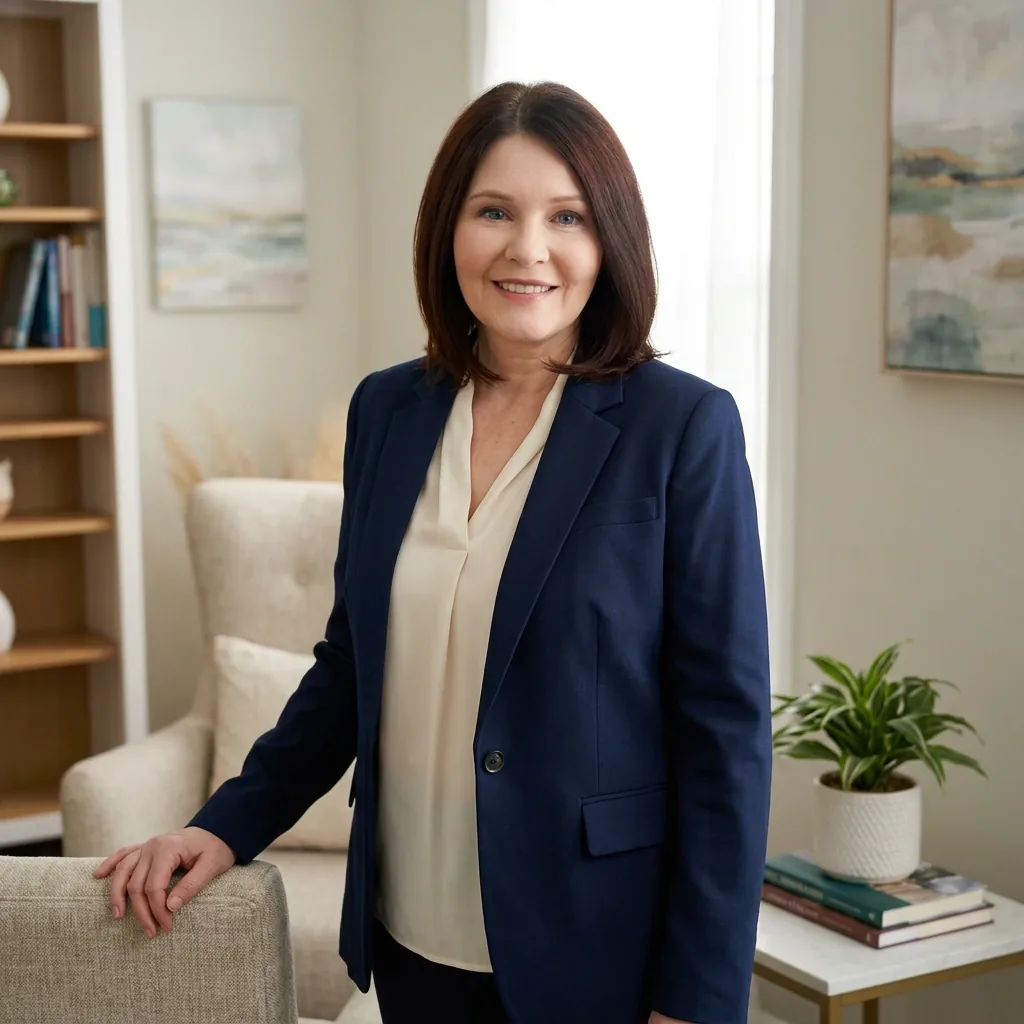
Colleen Makowsky
MA · LPC · NCC · CCTP · CAIMHP
Licensed counselor in Fort Lee, NJ. Adults across all of New Jersey by secure video.
MA in Community Counseling, Montclair State University. Completed the 18-credit CADC Certificate Program at Montclair State (not CADC credentialed) — CAIMHP Certified Addictions-Informed Mental Health Professional credentialed.
Trauma-informed (CCTP) · Motivational Interviewing · CBT · SFBT ·
OUR LOCATION
Online substance use counseling across New Jersey
I’m a service-area provider — I work with adults statewide by secure video. My base is Fort Lee, NJ (Bergen County), but you can see me from anywhere in New Jersey.
Hours
By appointment
Weekdays and weekends
Morning, afternoon, evening
Phone
(917) 519-8447
EXPLORE OTHER SERVICES
Types of therapy
Disordered-Eating Support · Anxiety Therapy · Depression Therapy · Self-Esteem & Life Transitions · Individual Therapy
Common questions about substance use counseling in New Jersey
Do you treat addiction?
“Addiction treatment” usually means detox, inpatient, or intensive outpatient treatment — those levels of care need a treatment center, not a solo counselor. I work with adults whose relationship with alcohol or substances is on their mind and causing distress, or who have completed a higher level of care and want ongoing support in recovery. If you’re not sure what treatment you need, we can discuss this on the 15-minute consultation.
What’s the difference between counseling with you and a treatment program?
A treatment program — detox, inpatient, intensive outpatient treatment — is structured care with multiple clinicians, group work, medication/medical oversight, and a defined protocol. I offer one-on-one outpatient counseling for adults who do not require a higher level of care.
Do you provide drug testing or coordinate with treatment programs?
I do not provide drug testing. I do not coordinate with treatment programs as a case-manager. If you’re working with a program team and want me as an outpatient counselor alongside, we can discuss this during the 15-minute consultation.
What credentials do you hold for substance use work?
I’m a Licensed Professional Counselor in New Jersey (NJ LPC #37PC00901900) with a CAIMHP credential (Certified Addictions-Informed Mental Health Professional). I completed an 18-credit Certified Alcohol & Drug Counseling Certificate Program at Montclair State University. The work I do is addictions-informed counseling.
What does insurance cover?
I accept Aetna, Cigna/Evernorth, Optum/UnitedHealthcare/Oxford, Horizon Blue Cross Blue Shield of New Jersey, Oscar, and Medicare. Medicaid is not accepted. Out-of-network billing is available — I can provide a superbill on request. For details, see insurance and cost.
How long are sessions?
38 to 53 minutes, occasionally 60 minutes if needed, online by secure video.
How long does counseling take?
Most clients work with me for 6 to 12 months — but it varies by individual. Substance use work in particular often involves an initial focused phase (weekly, 3-6 months) followed by a longer maintenance phase at reduced frequency.
What happens on the free 15-minute consultation?
You tell me what’s bringing you in, I ask a few questions about your symptoms, I tell you how I can help. We discuss whether substance use counseling is appropriate, or if a higher level of care would suit your needs. No charge. No pressure.
RELATED SPECIALTIES
Disordered-Eating Support in NJ · Anxiety Therapy in NJ · Self-Esteem in NJ
READY TO START?
Schedule your free 15-minute consultation
Reach out for a 15-minute consultation to see if Colleen can help, or if a higher level of care is needed.